Abstract
Aptamers (DNA or RNA sequences which bind to another molecule) are promising candidates for commercial aptamer-based biosensors (aptasensors). These devices aim to replace conventional antibody-based immunoassays which remain the dominant technology in the field. Immunoassays have several limitations, such as low stability and challenging synthetic protocols, that make aptamer-basedalternatives attractive. However, commercial translation has been limited by challenges such as reproducibility, reduced sensitivity in complex biological samples and limited selectivity. Although aptasensors have been explored in applications including diagnostics, illicit drug detection, food safety and proteomics, relatively few have achieved commercial success. Some commercial adoption has occurred in laboratory-based research or existing analytical workflows where these challenges can be overcome through sample preparation and supporting analytical techniques. Portable aptasensors continue to face challenges in point-of-care applications, primarily due to technical limitations outside of laboratory environments. This article discusses aptamers for several types of target molecules and weighs the relative successes of aptasensor development for those targets.
Introduction
Aptamers are short DNA or RNA sequences with high affinity for a target analyte which were first reported in 1990.1, 2 The field has remained highly active in subsequent decades, including a significant growth in aptasensor-based patent applications in the last ten years. However, substantial investment in aptamer research and an extensive publication history has yielded comparatively few commercially successful aptamer-based biosensors (aptasensors).
Aptasensors have several advantages over the more well-established antibody-based immunoassays, which remain the dominant competing technology. Immunoassays have a wide-range of commercial applications, but recognisable examples include pregnancy tests and COVID-19 rapid antigen tests. DNA structures (i.e. aptamers) are more stable than proteins (i.e. antibodies), allowing storage and operation under conditions that may compromise protein-based sensors, such as changes in heat or acidity. They are also sourced through chemical rather than biological synthesis, enabling highly reproducible manufacturing, simplified purification, scalable production, and, in many cases, lower manufacturing costs. Despite these advantages, aptasensors have achieved limited commercial adoption.
Common challenges facing aptasensors include signal reproducibility, reduced sensitivity in sample matrices and limited selectivity. Other challenges include regulatory roadblocks and competition from existing analytical tools. Recently, there has also been a particular emphasis in biosensor development (both immunoassays and aptasensors) on portable, point-of-care devices. This type of device introduces additional challenges to sensor development by limiting both the sample preparation and detection techniques available. Here, we will discuss several categories of aptasensors, the success of their commercialisation efforts and the reasons these efforts have often been unsuccessful.
The thrombin binding aptamer

Thrombin binding aptamers (TBAs) were among the earliest protein-targeting aptamers to be reported,3 and remain among the most extensively studied.4 Their size and relatively simple structure has made them the model of choice when testing aptasensor platforms. TBAs target thrombin, a key enzyme in blood clotting that has been implicated in vascular disease, cancer cell migration and Alzheimer’s disease.5-7 Conventional blood clotting assays measure downstream clotting parameters, such as strength or elasticity of blood clots, rather than thrombin directly. Direct quantification of thrombin is proposed as a means of improving early disease detection or monitoring.
Aptamers can be incorporated into many different types of sensors. For TBAs this has included electrochemical, fluorescence, colorimetric and surface-enhanced Raman spectroscopy platforms, exploiting either conformational changes in the aptamer (as in Fig. 1) or target-induced changes in the local environment.8 Electrochemical sensors have demonstrated particularly favourable analytical performance based on their speed, linear ranges, low limit of detection, performance in serum and the supporting technological developments.8 An example of an electrochemical aptasensor design is shown in Fig. 1, wherein a notable change in aptamer structure occurs upon target binding. This causes a redox label to move closer to the electrode surface and induces a measurable change in current. This approach is effective for many aptamers but is reliant on a large structural change. In other sensors, signals can be generated based on other changes in the sample environment, such as increased particle aggregation. As such, the choice of sensing technique is often dependent on the properties of the aptamer and obtaining aptamers with desirable properties for sensing, such as a large structural change upon binding, is one goal of current research.9
The principal obstacle to commercialisation for TBA aptasensors has been performance in complex biological matrices such as whole blood or plasma, which often results in a substantial decrease in sensitivity due to the presence of competing binders, including other proteins.10 This issue has been improved upon through aptamer refinement and amplification techniques over the last two decades, but to date, no thrombin aptasensors have received FDA approval. Reduced performance in complex matrices, combined with the high regulatory barriers associated with medical devices has limited widespread adoption of thrombin aptasensors. Furthermore, thrombin aptasensors are competing with well-established assays that are inexpensive, clinically validated and deeply integrated into healthcare workflows. While the advantage of a direct thrombin sensor is discussed above, so far, no aptasensor has been effective enough to displace the existing technology. Consequently, some recent research has focused on multiplexed aptasensing platforms capable of simultaneously detecting multiple disease biomarkers.11, 12 By testing for multiple diseases concurrently, aptasensors would have a clearer diagnostic advantage over current methods, potentially driving more widespread adoption.
Illicit drug detection
Detection of illicit drugs using aptasensors attracted particular interest among New Zealand forensic scientists prior to the implementation of roadside drug testing. Existing immunoassays are susceptible to false-positive and false-negative results, particularly for Δ9-tetrahydrocannibinol (THC, the psychoactive component in cannabis) and amphetamine-class drugs.13 A number of aptamers exist for targets such as cocaine14, 15, THC 16 and methamphetamine.17, 18 Ongoing development focuses on producing commercially viable aptasensors using these aptamers. However, similar to TBA, these sensors encounter interference in sample matrices, especially from salts and proteins present in saliva.19 Furthermore, cross-reactivity with structurally related prescription medications presents a particular challenge, as forensic screening assays require high specificity to avoid false-positive results with legal consequences.20
Improving aptamer sensing for small molecules requires a better understanding of the binding interactions involved. Small molecules present relatively few interaction sites, meaning aptamer binding is strongly influenced by competing binders, including salts, solvents and structurally similar molecules. This introduces additional challenges for optimising affinity, sensitivity and selectivity compared to protein-targeting aptamers like TBAs, as proteins can contain multiple binding sites.
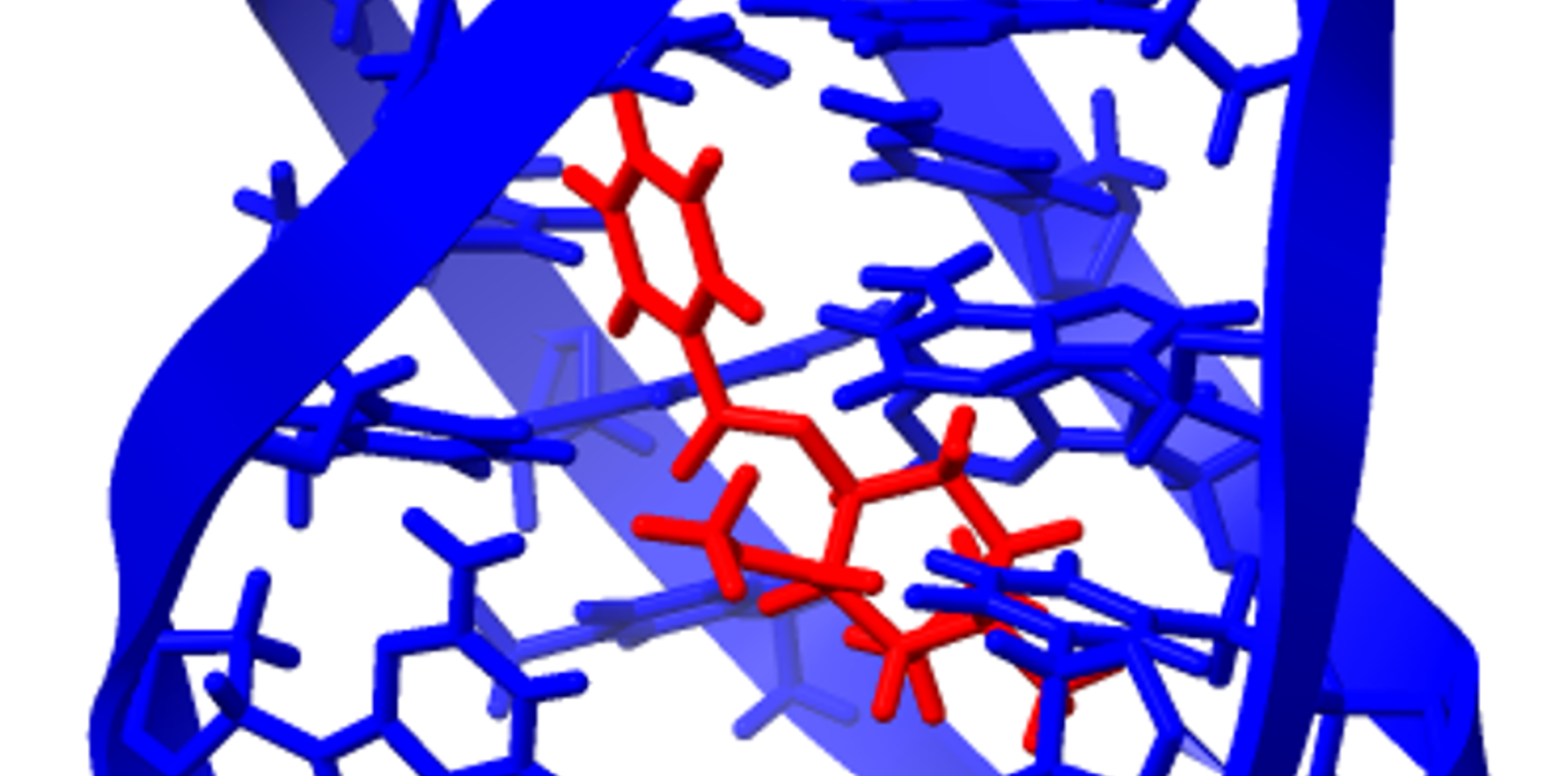
Empirical optimisation strategies focus on truncation or modification of aptamer sequences coupled with changes in sensor design.21-23 Recent research has shifted focus to a more rational aptamer engineering approach informed by structural characterisation and computational modelling. A computationally generated model of an aptamer bound to an illicit drug target, based on experimental data, is shown in Fig. 2. Complete structures of aptamer-target complexes are rare in aptasensor development, but improvements in modelling technology24-26 offer deeper insights into aptamer binding than previously possible. This in turn could enable more precision when modifying the aptamer or sensing platform. Investment in this field continues to yield improvements in the performance of portable aptasensors for illicit drugs but have yet to achieve a widespread commercial product. Achieving robust analytical performance in complex matrices remains a significant barrier to commercialization, meaning that immunoassays with known accuracy issues for certain targets continue to dominate the market.

Food safety
Food safety is one of the few areas in which aptamer-based technologies have achieved some meaningful commercial success. OTA-Sense, an aptasensor for ochratoxin A (OTA), uses an aptamer-based affinity column to extract OTA from food and beverage samples prior to analysis, typically by high-performance liquid chromatography (HPLC).27 In this application, OTA-Sense improves on an existing analytical workflow. While immunoassay-based approaches exist, OTA-Sense removes potential impurities from the food sample, which often pass through antibody-based systems.27 This bypasses the need for additional purification by eliminating potential contaminants prior to analysis.
OTA is a toxin produced by some Aspergillus and Penicillium moulds which can be found in a variety of commodities, including cereals, wine and beer. Similar methods are also described for other mycotoxins, such as aflatoxins,27 and aptasensors for other food safety hazards such as norovirus28 and Staphylococcus aureus29 are in development. Food safety aptamers are more commercially successful than thrombin or illicit drug aptamers largely because the testing requirements differ substantially. While food matrices are similarly complex, food samples routinely undergo extraction and purification prior to analysis, allowing aptamers to operate in controlled sample matrices rather than directly in untreated biological fluids. Food safety contexts are also more compatible with multi-step analytical pipelines than point-of-care testing.
OTA-Sense and similar technologies function primarily as a preliminary test or isolation method, but redundancy can be achieved through multiple layers of testing. Potential false positives or negatives can therefore be validated by other analytical methods, such as HPLC. Unlike TBA or illicit drug aptamers, the goal of aptasensors for foodborne hazards is to improve, rather than replace, existing approaches. Their relative success therefore reflects not only the performance of the aptamers themselves but finding a more compatible application for the available technology.
Slow off-rate modified aptamers (SOMAmers)
Although commercial aptasensors, including those for foodborne hazards, remain relatively uncommon, aptamers have achieved more success in laboratory-based research applications. For example, the SOMAscan platform which was brought to market in 2015 by SomaLogic, Inc. is a useful tool in proteomics studies (a characterisation of all proteins in a given organism or system) where comprehensive antibody-based assays are unavailable.30 This platform uses a highly multiplexed aptamer system to simultaneously detect biomarkers for around 11,000 proteins.31
SOMAmers incorporate chemically modified nucleotides to expand the range of molecular interactions available during target binding, enabling high-affinity recognition of a broad range of proteins. Selection for slow dissociation kinetics (t½ > 30 min) further improves assay performance by favouring aptamers that remain bound during washing steps.30 The combination of these innovations has allowed SomaLogic to produce high affinity aptamers and a corresponding assay that identifies a large library of proteins. However, unlike portable aptasensors, SOMAscan is designed for centralised laboratory analysis. This enables extensive sample preparation, amplification and fluorescence-based detection. These conditions allow the platform to exploit the strengths of aptamers without the constraints imposed by the point-of-care or field-based applications described above.
While the success of SOMAscan does not preclude the future commercial success of portable aptasensors, it does emphasise the advantages of laboratory-based sample preparation and, conversely, the challenges of translating aptamer technologies from controlled laboratory settings to field applications.
Conclusions
Despite the promising properties of aptamers as replacements for antibody-based immunoassays, they have only achieved limited success in commercial application since their discovery. A recurring challenge for portable aptasensors has been matrix interference, which significantly reduces sensitivity in biological fluids. Simplified sample preparation and complementary testing methods in foodborne hazard detection reduces this problem. Laboratory-based detection allows for extensive sample preparation and analytical controls to minimise it further. Moreover, in many cases cross-reactivity has limited aptasensor development due to interactions with structurally similar molecules, including legally prescribed drugs or benign compounds present in samples.
These challenges are being addressed through both empirical and rational approaches. Sequence truncation, chemical modification, improved selection strategies and alternative sensing architectures are being used to optimise aptamer performance, while structural characterisation and computational modelling are increasingly informing rational aptamer design.
Overall, commercial success has depended less on the inherent advantages of aptamers over antibodies and more on finding applications that align with the current capabilities. While laboratory-based aptasensing has demonstrated clear commercial value, portable aptasensors require further improvements in sensitivity, selectivity and robustness under real-world conditions.
References
- Ellington, A. D.; Szostak, J. W. Nature 1990, 346 (6287), 818-822. DOI: 10.1038/346818a0
- Tuerk, C.; Gold, L. Science 1990, 249 (4968), 505-510. DOI: 10.1126/science.2200121
- Bock, L. C.; Griffin, L. C.; Latham, J. A.; Vermaas, E. H.; Toole, J. J. Nature 1992, 355 (6360), 564-566. DOI: 10.1038/355564a0
- Murray, M. T.; Wetmore, S. D. Nucleic Acids Res 2024, 52 (18), 10823-10835. DOI: 10.1093/nar/gkae729
- Krenzlin, H.; Lorenz, V.; Alessandri, B. J Neurosci Res 2017, 95 (10), 2080-2085. DOI: 10.1002/jnr.24049
- Yin, X.; Wright, J.; Wall, T.; Grammas, P. Am J Pathol 2010, 176 (4), 1600-1606. DOI: 10.2353/ajpath.2010.090406
- Tsopanoglou, N. E.; Maragoudakis, M. E. Semin Thromb Hemost 2004, 30 (1), 63-69. DOI: 10.1055/s-2004-822971
- Sun, H.; Wang, N.; Zhang, L.; Meng, H.; Li, Z. Chemosensors 2022, 10 (7). DOI: 10.3390/chemosensors10070255
- Tenaglia, E.; Spiga, F. M.; Guiducci, C. Methods Mol Biol 2018, 1811, 183-197. DOI: 10.1007/978-1-4939-8582-1_13
- Bini, A.; Minunni, M.; Tombelli, S.; Centi, S.; Mascini, M. Anal Chem 2007, 79 (7), 3016-3019. DOI: 10.1021/ac070096g
- Mahmoud, M.; Ruppert, C.; Rentschler, S.; Laufer, S.; Deigner, H.-P. Sensors and Actuators B: Chemical 2021, 333. DOI: 10.1016/j.snb.2020.129246
- Kovvali, S.; Beckles, C. A.; Chandrasekaran, A. R.; Halvorsen, K. bioRxiv 2026. DOI: 10.64898/2026.05.01.722269
- Liut, J.; Bott, U.; Madea, B.; Kramer, M.; Maas, A. Drug Test Anal 2022, 14 (8), 1407-1416. DOI: 10.1002/dta.3262
- Baker, B. R.; Lai, R. Y.; Wood, M. S.; Doctor, E. H.; Heeger, A. J.; Plaxco, K. W. J Am Chem Soc 2006, 128 (10), 3138-3139. DOI: 10.1021/ja056957p
- Alkhamis, O.; Canoura, J.; Wu, Y.; Emmons, N. A.; Wang, Y.; Honeywell, K. M.; Plaxco, K. W.; Kippin, T. E.; Xiao, Y. J Am Chem Soc 2024, 146 (5), 3230-3240. DOI: 10.1021/jacs.3c11350
- Rosenthal, M.; Pfeiffer, F.; Mayer, G. Angew Chem Int Ed Engl 2019, 58 (31), 10752-10755. DOI: 10.1002/anie.201903479
- Ebrahimi, M.; Hamzeiy, H.; Barar, J.; Barzegari, A.; Omidi, Y. Sensor Letters 2013, 11 (3), 566-570. DOI: 10.1166/sl.2013.2824
- Erkocyigit, B.; Man, E.; Efecan, E.; Ozufuklar, O.; Devecioglu, D.; Bagci, B.; Aldemir, E.; Coskunol, H.; Evran, S.; Guler Celik, E. Biosensors (Basel) 2025, 15 (1). DOI: 10.3390/bios15010031
- Liu, Y.; Pandey, R.; McCarthy, M. J.; Raymond, O. Anal Chem 2025, 97 (2), 1097-1106. DOI: 10.1021/acs.analchem.4c03423
- Yu, H.; Luo, Y.; Alkhamis, O.; Canoura, J.; Yu, B.; Xiao, Y. Anal Chem 2021, 93 (6), 3172-3180. DOI: 10.1021/acs.analchem.0c04592
- Neves, M. A.; Reinstein, O.; Johnson, P. E. Biochemistry 2010, 49 (39), 8478-8487. DOI: 10.1021/bi100952k
- Neves, M. A. D.; Shoara, A. A.; Reinstein, O.; Abbasi Borhani, O.; Martin, T. R.; Johnson, P. E. ACS Sens 2017, 2 (10), 1539-1545. DOI: 10.1021/acssensors.7b00619
- Naseri, M.; Halder, A.; Mohammadniaei, M.; Prado, M.; Ashley, J.; Sun, Y. Electrochimica Acta 2021, 389. DOI: 10.1016/j.electacta.2021.138644
- Abramson, J.; Adler, J.; Dunger, J.; Evans, R.; Green, T.; Pritzel, A.; Ronneberger, O.; Willmore, L.; Ballard, A. J.; Bambrick, J.; et al. Nature 2024, 630 (8016), 493-500. DOI: 10.1038/s41586-024-07487-w
- Honorato, R. V.; Trellet, M. E.; Jimenez-Garcia, B.; Schaarschmidt, J. J.; Giulini, M.; Reys, V.; Koukos, P. I.; Rodrigues, J.; Karaca, E.; van Zundert, G. C. P.; et al. Nat Protoc 2024, 19 (11), 3219-3241. DOI: 10.1038/s41596-024-01011-0
- Cavalluzzi, M. M.; Mangiatordi, G. F.; Nicolotti, O.; Lentini, G. Expert Opin Drug Discov 2017, 12 (11), 1087-1104. DOI: 10.1080/17460441.2017.1365056
- Penner, G. IVD Technology 2012, 18, 31-37.
- Liu, D.; Zhang, Z.; Yin, Y.; Jia, F.; Wu, Q.; Tian, P.; Wang, D. Talanta 2019, 193, 199-205. DOI: 10.1016/j.talanta.2018.09.084
- Zhu, A.; Ali, S.; Xu, Y.; Ouyang, Q.; Chen, Q. Biosens Bioelectron 2021, 172, 112806. DOI: 10.1016/j.bios.2020.112806
- Gold, L.; Ayers, D.; Bertino, J.; Bock, C.; Bock, A.; Brody, E. N.; Carter, J.; Dalby, A. B.; Eaton, B. E.; Fitzwater, T.; et al. PLoS One 2010, 5 (12), e15004. DOI: 10.1371/journal.pone.0015004
- Kraemer, S.; Schneider, D. J.; Paterson, C.; Perry, D.; Westacott, M. J.; Hagar, Y.; Katilius, E.; Lynch, S.; Russell, T. M.; Johnson, T.; et al. J Proteome Res 2024, 23 (11), 4771-4788. DOI: 10.1021/acs.jproteome.4c00411